For many families, the move from primary school into secondary education is expected to feel like a natural progression. Children move from P7 into S1, and the assumption is that learning simply continues at the next level.
In reality, the transition is often more complex.
Secondary school introduces faster-paced lessons, subject-specific teaching, and a greater expectation of independence. While many pupils adapt well, others begin to find that concepts in English and maths feel less secure, or more difficult to apply.
At LS Tuition, we support pupils in S1, S2 and S3 not only by strengthening underlying skills, but also by confidently teaching the current curriculum content they are working on in school.
Primary and Secondary Learning: Understanding the Difference
The difference between primary and secondary education is not simply a change in content; it is a shift in how learning is delivered and experienced.
Primary teaching is typically:
- Structured and sequential
- Responsive to individual understanding
- Focused on building core skills alongside knowledge
Secondary teaching often involves:
- Subject-specialist delivery
- A quicker pace through topics
- Less time to revisit underlying gaps
- Greater expectations of independent learning
This means that even when pupils are capable, they may struggle to keep up if explanations move on before understanding is fully secure.
Students benefit most when teaching is closely matched to their current level of understanding, which is something that can be more difficult to achieve in larger secondary classrooms.
Our Expertise: More than Foundations
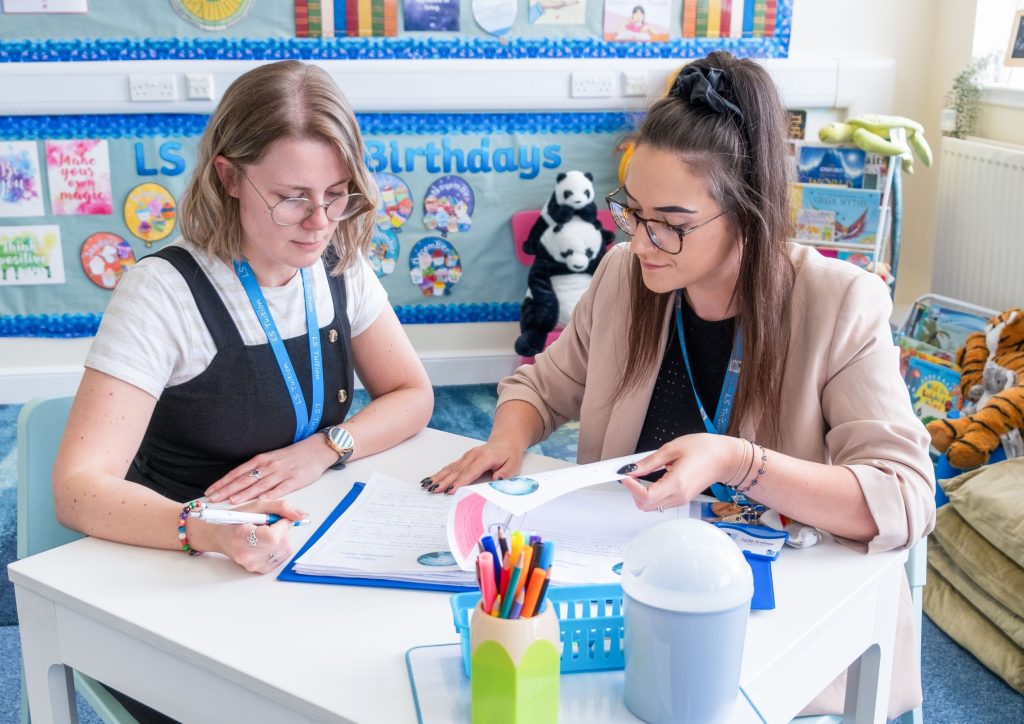
At LS Tuition, we are fully qualified primary teachers with extensive experience teaching up to the end of primary and into early secondary level.
This means two things:
1. We can teach S1-S3 English and maths content with confidence
We regularly support pupils with:
- S1-S3 maths topics
- Reading and comprehension at a secondary level
- Structured and analytical writing
- Applying skills across different contexts
2. We understand why pupils may struggle with that content
Because of our training and experience, we are particularly skilled at:
- Breaking down complex ideas into manageable steps
- Identifying exactly where understanding has broken down
- Adapting explanations until they make sense
- Connecting new learning to prior knowledge
This combination is what allows pupils not just to ‘keep up’, but to genuinely understand what they are being taught.
Teaching at the Right Level: How it Works in Practice
One of the most important aspects of our approach is that we teach based on learning level, not just school year.
In practical terms, this means:
- If a pupil is confident, we support and extend their current work
- If a concept isn’t secure, we briefly step back to address the gap
- We then return to current classwork with stronger understanding
For example, an S2 pupil learning algebra may struggle not because of algebra itself, but because earlier number concepts are not fully secure.
By addressing both simultaneously, we ensure that:
- Current schoolwork becomes more manageable
- Confidence improves
- Progress is sustained over time
New learning is most effective when it builds on secure prior knowledge.

Not Just Catching Up but Keeping Up and Moving Forward
A common misconception is that additional support is only about ‘catching up’.
In reality, many of the pupils we work with are capable learners who simply need:
- Clearer explanations
- More time to process new ideas
- Space to ask questions
- Reassurance as they build independence
At LS Tuition, sessions are designed to support both:
- Current classroom learning, and
- Longer-term skills development
This ensures that pupils are not only addressing gaps but also continuing to progress with their peers. This is particularly important when we consider how learning in English and maths connects to the wider curriculum.
How Strong Literacy and Numeracy Support Learning Across All Subjects
While English and maths are often seen as subjects in their own right, they also underpin almost every aspect of learning in secondary school.
In subjects such as history, geography and the sciences, pupils are expected to:
- Read and interpret increasingly complex texts
- Understand subject-specific vocabulary
- Follow multi-step instructions
- Organise and communicate their ideas clearly
- Apply reasoning and problem-solving skills
When literacy and numeracy skills are not fully secure, these tasks can quickly become overwhelming, even if a pupil understands the topic being taught.
For example, a pupil may grasp a scientific concept but struggle to explain it in writing, or understand a historical topic but find it difficult to interpret source material. In maths, gaps in number confidence can make it harder to access topics in physics and chemistry.
Improving literacy has a positive impact across the wider curriculum, not just in English lessons. By strengthening these core skills, pupils are better able to:
- Access and engage with a wider range of subjects
- Understand instructions and questions more clearly
- Express their knowledge with greater confidence
- Approach unfamiliar tasks with more independence
At LS Tuition, this is a key part of our approach.
By supporting literacy and numeracy alongside current learning, we help pupils not only improve in English and maths, but also feel more capable across the curriculum as a whole.
Building Independent Thinkers
Alongside subject knowledge, we place a strong emphasis on developing independent learning skills.
This includes:
- Encouraging pupils to explain their thinking
- Teaching strategies for approaching unfamiliar problems
- Building resilience when work feels challenging
- Gradually reducing reliance on adult support
Metacognition and self-regulated learning are key drivers of pupil progress, particularly in the secondary years. Our aim is that pupils leave sessions not just with answers, but with a clearer understanding of how to learn.
A Clear Boundary: Exam-Level Tuition
While we are confident in supporting pupils in S1, S2 and S3, it is important to be clear about our scope.
We do not provide tuition for National 54, National 5, GCSE’s or other exam-level qualifications.
We specialize in the stage before this, where we build understanding, confidence, and strong learning habits.
Why Choose LS Tuition?
LS Tuition offers something slightly different from traditional secondary tutoring.
We combine:
- The ability to teach S1 – S3 English and maths effectively
- Deep understanding of how children develop core skills
- Personalised, 1:1 teaching
- A calm and confidence-building approach
This means students receive support that is both academically relevant and carefully tailored to how they learn best.
For many families, this is what makes the difference.
Supporting Your Child Through Early Secondary
If your child is in S1, S2 or S3 and finding English or maths more challenging than expected, the issue is often not ability, but the pace and structure of learning.
With the right support, pupils can:
Understand current classwork more clearly
Rebuild confidence
Develop Stronger independent learning skills
Feel more positive about school
At LS Tuition, we are here to support that process by teaching both the content your child is learning now and the skills they need to succeed moving forward.
Frequently Asked Questions
Yes. We support pupils in S1, S2 and S3 in English and maths, including both current schoolwork and underlying skills.
Yes. Our tutors are fully qualified primary teachers with strong experience teaching and explaining early secondary English and maths.
No. We support both current class topics and any gaps, helping pupils keep up and build confidence.
We align with your child’s school learning where helpful, while adapting lessons to their individual level and needs.
No. We do not provide National 4/5 or GCSE support. We focus on S1–S3 learning and foundations.
We specialise in how children learn, breaking down concepts clearly and building confidence alongside understanding.
Yes. Many pupils benefit from support to build confidence, keep up, and strengthen understanding.
We start tuition with an extensive assessment to understand each child’s learning level. This is always our starting point.
As understanding improves, pupils feel more capable, ask more questions, and become more independent learners.